Thompson & Morgan Gardening Blog

Our gardening blog covers a wide variety of topics, including fruit, vegetable and tree stories. Read some of the top gardening stories right here.

Propagation, planting out and cultivation posts from writers that know their subjects well.

La Bonnotte – Chitting the most expensive potato in the world?

Being a plant breeder and having a young family doesn’t leave me a lot of time for leisure gardening, but still, as an unashamed plant geek, I can’t resist indulging in a few plants and veg. This month is all about a humble potato.

In early February I started chitting tubers of a very special potato on my windowsill: La Bonnotte. Being French you may think I am a bit biased, but of all the potato varieties I have ever had the chance of tasting, this definitely tops my gourmet list. Sautéed whole in their skin, simply with salted butter and herbes de Provence, they are truly divine, with an unforgettable sea-like, sweet, citrusy and chestnutty note. It’s important to cook them in their skins to keep the taste, but the inward eyes would make peeling almost impossible anyway. I had ordered 2kg of seed potato and when they arrived, I was very tempted to cook some straight away… This was far worse than the Stanford marshmallow experiment, but I shall wait until harvest time!

la bonnotte

La Bonnotte is normally grown on the small island of Noirmoutier, where the light sandy soil, oceanic microclimate and the addition of seaweed all participate in developing the unique flavour. It may also have to do with the absolute TLC every plant receives: La Bonnotte is planted by hand using the old technique of lazy beds – definitely not for the lazy gardener – which are essentially wide, parallel raised beds without any wooden borders. On the mere 5 hectares where they are grown, the tubers are planted on the 2nd of February and harvested before maturity 90 days later. The backbreaking job of harvesting and severing the growing tubers from the mother plant is again all done manually; machine harvest would just ruin the soft skins and delicate aromas.

With the mechanisation of agriculture in the 60s, La Bonnotte very nearly became extinct, but it was saved in extremis by passionate Noirmoutier growers and the INRA in the 90s. By April 1996, it was ready to go back on the market to the delight of chefs and gourmets alike. The first hand-harvested crop of 5 kg was auctioned and fetched the incredible price of €2,300, making La Bonnotte the most expensive potato in the world. Nowadays the price is more like €10 a kilo for the very first ones, still a high price for a spud!

Now back to reality. I very much doubt I’ll have the time and dedication to build lazy beds and add Irish moss seaweed when my own La Bonnotte tubers are finally ready for planting. I think I’ll plant some in the ground and some in bags. I’ll also be growing some tasty Jazzy as backup and comparison. Suffolk is a tad colder than Noirmoutier so I plan on planting in early March and won’t be able to taste them until the end of May. By then I’ll know if La Bonnotte tastes just as good without the influence of the sea, even if in Noirmoutier it has been nicknamed pomme de mer.

How to Choose The Best Plants to Compliment Your Pond

Getting the right balance of plants is essential for a healthy and thriving pond habitat.

To achieve good visual interest, you may wish to consider getting a combination of foliage and flowers sitting at different levels in and around your pond; bearing in mind that most plants only flower for a few months out of the year.

It is therefore useful to take a note of the height or planting depth, spread, and flowering season of your favourite varieties of pond plant, in order to plan effectively.

You will also need to calculate the pond surface area and depth, to avoid overcrowding, and to ensure that the plants grow to the perfect height in the water.

The positioning of plants is a crucial aspect and will depend on the plant type.

read more…

Chronicles of Kate – Garden Design: Dilemmas, Delphiniums and Monty Don

I love to look at garden magazines- in fact this is one of the highlights of my Sunday morning along with listening to Gardener’s Question Time on BBC Radio 4. I find the programme both amusing and informative and being on the radio makes it even better.

Why is this? Because at least on the radio I am not looking at the gardens while the topic of the programme is, for example, on the use of herbaceous perennials in borders. I am interested in this very subject because I have been struggling to get my borders to look good and it has taken quite a long time. I had a few things in the main one last year – it is south facing so good for anything that needs a lot of sun but can get really hot plus the soil is not great at all; dry and full of small stones.

lavenders

Since I started my garden, I have become quite a gardening geek when it comes to making sure I plant what will grow there versus what I would like to grow. In fact, I have gone so far as to plant things I don’t really like i.e. 48 lavender plug plants (can you honestly tell the difference between a Hidcote and a Munstead?) I couldn’t go into my living room for a week and when I did it made me feel sick – there was nothing soothing or relaxing about it – except for when I had to get outside for a relaxing walk to get rid of my headache (isn’t lavender meant to help you relax?). I just found the whole lavender thing really stressful in the end but I thought I would try them since they do well on poor soil.

vegetables

I am not a fan of either cucumbers or runner beans – possibly courgettes in the form of cake smothered in lemon poppy seed icing. But I have a small garden and a lot of the easy to grow vegetables recommended for small spaces are not what I would like to grow, in fact last year caused me more effort than if I had just grown a patch of mint or other herbs – thyme for example – useful for just about any culinary adventure. Note! Do not plant courgettes or cucumbers if you don’t have an outdoor tap – and are not prepared to lug buckets and bucket of water outside. (I am now on more than friendly terms with Thames Water).

My point to this is that you should not be persuaded to plant what you don’t want to because it is recommended in a magazine and because it is easy to grow. Who is growing these vegetables and what is the definition of easy? Turn to Monty Don and his very easy crop of cucumbers – the kind suitable for a small space – usually these are the F1 Hybrid types – I still don’t know what the F stands for but I am sure every gardener trying to grow these easy veg could come up with a few words and I don’t think it would be fork, fertilizer or farmyard. An aside here- why are gardeners put into this stereotype of passive types poking around in the veg patch looking complacent conjuring up imagines of Franciscan friars taking time off from prayers to check out the grapes for the next wine harvest. It sounds ideal- but isn’t the picture in my garden or I would think in a lot of gardens. Gardeners come in all forms but I can imagine there are a few Gardening versions of Gordon Ramsey- in fact Alan Titchmarsh made a few comments about this in one of his monthly articles in Gardeners World magazine pointing out that some of the expletives coming out of the garden shed would make your hair curl or at least get your tomatoes to ripen a few months earlier than anticipated.

show garden

Leaving the F1 hybrids aside, let’s take a look at the influence of gardening magazines. Why is it that every time I sit down to flip through the pages of the latest copy of a gardening magazine I go from looking forward to the helpful advice of the expert gardeners to putting my tea down and almost crying by the time I get to the page 3 centre fold garden of the month- of which the garden belongs to a reader of the magazine that has sent the photo in as a standard to strive for and an indication of what all gardeners can do with a bit of determination and a bag of money received after discovering the Roman coin in the poor soil. I ask you. I am not convinced that having a half acre garden on Scilly where the front entrance is adorned with massive pots of banana plants is a very practical example. Moving on to the next shot of the two owners standing on a lawn surrounded by herbaceous borders growing 5 foot delphiniums ( tip- these make a stunning display at the back of a border) does it need to be said?

soil testerIf you are happy to go ahead with the soil you have then I would suggest that you take the time to do a soil test to find out the type. I made this mistake with the lavender because after all the fuss about it and the time it took to bring on all the plug plants and after taking the time to read up on the type of soil conditions which involved mixing in a good amount of horticultural grit- after all of this they haven’t done very well because I forgot about testing to find out the type of soil- acidic or alkaline. I will be taking a look at this topic in my next post along with how to improve your soil after you are familiar with it giving you more choice of what to grow using basic composts and organic matter without over doing it and spending too much money but keeping in mind plants that will grow well in the specific type including conditions i.e. clay, poor drainage, silty etc.

I look forward to any comments and while talking about delphiniums – should we have a Delphinium growing contest? Or how about Larkspurs?

Surprising Household Products That Benefit Your Garden

Reduce, reuse, recycle- it’s a phrase that has been drummed into everyone in the last decade. Repurposing in the garden is a hot trend at the moment, and saving money isn’t the only benefit. Your garden is an ecological haven, so it makes sense to use natural products wherever possible, keeping harsh chemical fertilizers and pesticides to a minimum (something also worth bearing in mind if you have little hands helping out).

read more…

An Interesting Winter Garden by the Sea

winter garden

At this time of year, it’s always difficult to maintain an interesting looking garden that you can be proud of, especially when you are located on the coast! In recent years, I’ve been extremely pleased with my beach garden, created back in 2012. The small plot sits at the front of my chalet bungalow, facing the sea, about a quarter of a mile away. It has to take everything the elements throw at it.

We get very strong winds blowing off the sea many times during the year! I’d always seen it playing second fiddle to the main back garden, but over the years I’ve begun to realise that it is always capable of holding its own and looks quite amazing, despite what the weather throws at it, especially when the sun sets over it.

More importantly, it is incredible how low the overall maintenance on this part of the garden is compared to the rest of my plot. Surprisingly, a professional garden photographer shot the beach garden this month as well. All my pictures here were taken mid-January, through to early February.

arabis, boat and bergenia

The Arabis ferdinandi-coburgi ‘Old Gold’ is looking really stunning by the steps up from the street, in amongst the grasses and the euonymus fortuneii Emerald Gaiety. You can see the horizon and the sea in the background. Dazzling along the front of the old weathered rowing boat, the bergenia flowers are quite striking. The boat itself, which is the centrepiece of the front beach garden, is now surrounded by plants and shrubs. There is a large sea buckthorn on the right of it that may have shed its leaves for the Winter but it’s silver grey frame still leaves its mark on the landscape.

cornonilla, rosemarium

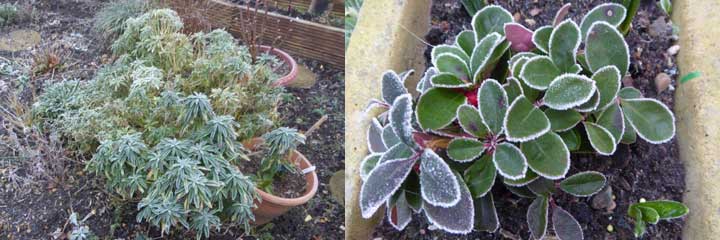
Brimming over the edge of the dinghy you can see the amazing bright yellow flowers of the coronilla valentina glauca, which really catch your eye at this time of year, along with the pale lemon flowers of the large hellebore argentifolius. The eclectic mix of object d’art around the garden, old reclaimed anchors, rusty wheels, lobster pots and reclaimed groynes all help to maintain the character of the plot all year around, not to mention the large pieces of driftwood too.

miscanthus

We’ve had a lot of mist and fog hang over the garden since Christmas and it really gives an interesting, if eerie feel to the beach garden. Flowering this week by the boat are the delicate flowers of the rosemarium officianalis rosea. Not far away the elegant plumes of the Miscanthus Morning Light Maiden rise up and catch the evening sunlight perfectly.

So, if you’re looking for a relatively low maintenance garden to create yourself, maybe a beach garden is a good choice. What’s more, you don’t actually have to live by the sea. You could create your dream plot wherever you like – take a look at our winter flowers hub page for inspiration. You can read more about the garden and when it will open for the season in 2017 at www.driftwoodbysea.co.uk

Dance, Dance, Dance!

Many people at work here at T&M know that I am an avid dancer, I’ve even encouraged a few others from my office to come along and try Ceroc (the dance I love to do) and they’ve enjoyed it too!
This got me thinking recently, as I start to plan out my garden pots for this year; why not have a section dedicated to dance, after all, if I can combine my two passions, dancing and gardening then surely I’ve got the best of both worlds?

read more…

Thompson & Morgan Triallist’s Blog – February 2017

overall view in February

January? Where did that go?

So it’s February already and there’s been precious little activity going on of the horticultural variety! I can’t remember a year when frost was so heavy and so prolonged. The water features and borders were frozen solid for a fortnight, although mercifully not much rainfall to drown the perennials in their beds.

read more…

Discovering What Is in Your Garden: Making Seed Compost

In the last year, I have spent more money on gardening than anything else.

This year, I decided to do what I could on my own and research the methods to reduce cost and learn something new about gardening at the same time. It is simple really when you consider traditional gardening methods which probably involved planting what would grow by taking a good look at the soil and going by the general environmental conditions in your area. Where I live it is chalk downs and for the most part this is the soil that I have in my garden. Over time, I have learned about the soil by the types of plants that are growing there naturally. Knowing your garden very well in all aspects and especially the soil is the one thing I have discovered will save time and money.

read more…

Amanda’s January Gardening Update

Hello Gardeners,

January, supposedly named after the god Janus, a two headed figure who could look to both the future and the past, the reason why we make resolutions at this time of year, to change things in our life. So it’s no surprise then, that we gardeners are very probably this month perusing seed catalogues, drawing up plans, and generally getting our kit ready for the growing year.

read more…

Planning a Cutting Garden

This season I have decided to start my own cutting garden, mainly because I find I am totally incapable of cutting flowers from the garden to bring into the house. I end up buying cut flowers from the supermarket because I can’t bear to denude my own garden plants. This can prove quite costly, and, by growing my own, I could save around five pounds a week, which amounts to an annual saving of around two hundred and fifty pounds. That is one very good reason to give it a go! I have also found that I have a very limited choice of variety and colour when buying flowers in a supermarket.


Cut flower varieties are chosen by professional growers, primarily for their length of vase life and their ability to withstand the rigours of long distance travel. This limits the number which would be suitable, and thus, the degree of choice in the shops. There will never be, for instance, sweet peas for sale in the local supermarket, as their vase life is only 3 – 5 days, and they are so delicate that they would be easily damaged in transit. As my cut flowers will only have to travel up the garden path, I can choose whichever varieties take my fancy. And if they die after a few days, there will be plenty more in the cutting patch to take their place.

I can also choose varieties for a specific reason, such as fragrance, which is very important to me, so I can choose flowers for their scent alone, if I want to. I love rich, jewel – like colours, so I can select a personal colour palette of purples, reds and strong blues, as well as oranges and hot pinks, which will complement each other well in a vase. I can also select for flower type, shape, size and textures to help me to achieve my ideal arrangements. There is a great creative freedom in growing your own cut flowers, which is lost in the selection of a bunch of supermarket roses.

I have already chosen and bought my seeds – many are Thompson & Morgan annuals, but I have had to go further afield for some more unusual varieties, like Bupleurum rotundifolium ‘Griffithii’, Nicotiana ‘Lime Green’, Anchusa Capensis ‘Blue Angel’ and Melianthus Major.

Choosing was an absolute labour of love and one of my favourite jobs of the whole year! Once they arrived I drew up a sowing plan, based on the sowing information given on the packet, and my own experience from previous years. I tend to wait, for instance, to sow cosmos until light levels are good, as my early sown seedlings have often been leggy and weak. Later sowings have been much more robust.

So, the propagator is on, and … there are babies! The first seeds have germinated, so they will be moved out of the propagator onto a warm, light windowsill to grow on, leaving space for the germination of the next batch of seeds. And repeat!

It must mean that spring is just around the corner …

Jane Scorer
Hoe hoe grow
www.hoehoegrow.co.uk

Meet the experts

The T&M blog has a wealth of knowledgeable contributors. Find out more about them on our "Meet the experts" page.

Award-Winning Plants & Seeds

Create a show stopping display in your garden with our award-winning plants and seeds.

Archives

Pin It on Pinterest